
In 1985, Anne White walked onto a Wimbledon court in a white catsuit and leg warmers. The colour was familiar. The silhouette was anything but routine. Her appearance exposes a useful flaw in the idea that limiting a wardrobe to white must make everyone look the same.
Wimbledon has an exceptionally strong visual identity. Yet within its pale palette, players have found ways to express humour, elegance, theatricality and their own sense of sporting style. The restriction is part of the fashion story, not the end of it.
A colour becomes an institution
The official Wimbledon compendium records the introduction of a requirement for predominantly white clothing in 1963, followed by a tighter formulation in 1995. The familiar aesthetic is therefore both a tradition and something actively defined over time.
That matters because traditions can look inevitable from a distance. In practice, someone writes them down, interprets them and decides which details belong. A dress code is also a form of visual editing: it narrows the palette through which a tournament presents itself.
The silhouette still has room to move
Wimbledon’s own fashion retrospective identifies White’s 1985 catsuit and, two decades earlier, Lea Pericoli’s rose-trimmed dress by Teddy Tinling. These are very different propositions within a shared colour vocabulary.
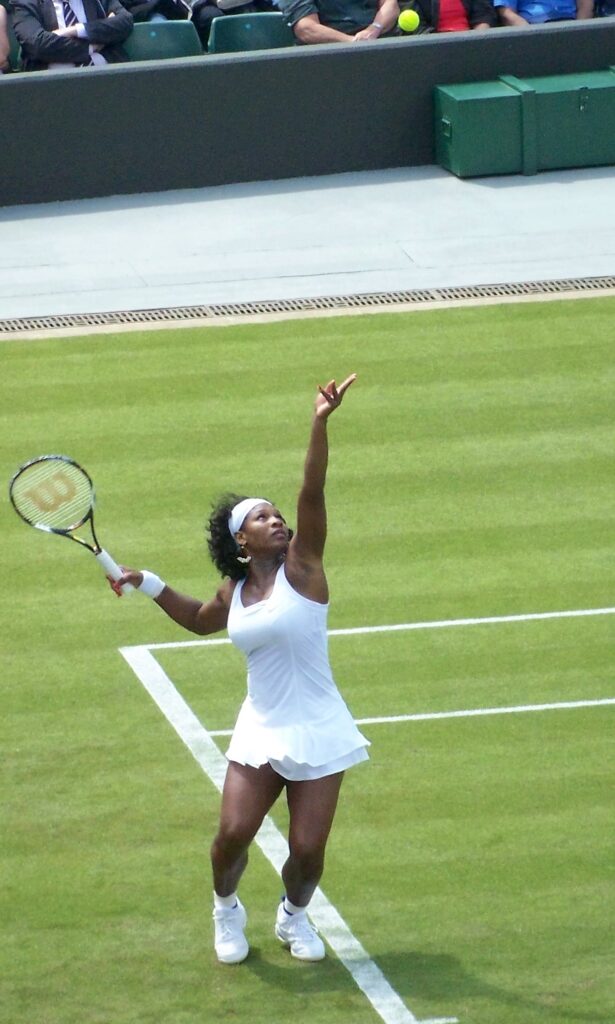
The contrast is the interesting part. One can read as streamlined, another as embellished. Limiting colour makes other choices more apparent: the shape of a sleeve, the position of a hem, the relationship between a garment and a moving body. White does not remove design. It changes where the eye looks for it.
A remarkable wardrobe in 2008
The same official retrospective gathers three especially revealing examples from 2008: Maria Sharapova’s tuxedo-inspired look, Serena Williams warming up in a mini trench coat, and Roger Federer appearing in a cardigan with gold trim.
The references reach beyond sportswear into other wardrobes. A tuxedo brings the vocabulary of formal evening dress. A trench suggests outerwear and arrival. A cardigan makes room for a different register of polish. Each borrows an idea without needing a completely different colour scheme to announce it.
These moments also remind us that a tennis appearance unfolds in stages. What a player wears on arrival or while warming up is not necessarily the garment in which every point is played. The whole entrance can carry an image.
The background helps make the statement
Wimbledon’s grass-court account describes the carefully maintained ryegrass behind the familiar green setting. Against that surface, white clothing becomes part of an instantly legible sporting composition.
The effect is a relationship between person and place. Remove the court and an outfit is one object; return it to that setting and it participates in a much larger visual identity. Players can work within that identity while finding ways to remain recognisable as themselves.
The lasting appeal of Wimbledon whites is not that they erase fashion. The archive makes the opposite case. A strong framework can make a small difference conspicuous, and sometimes a white catsuit can say more than a whole wardrobe of colour.