
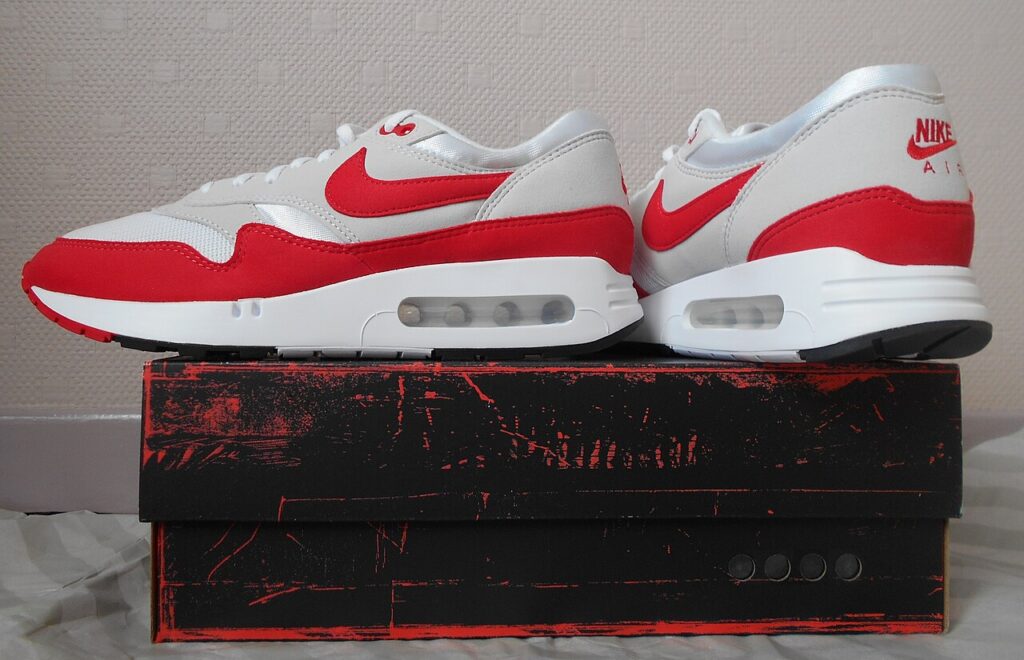
The decisive detail on the Nike Air Max 1 is a small opening in its sole. You can change the colours above it and still return to that window: the part of the shoe that offers a glimpse of what is usually hidden.
Tinker Hatfield’s design turned technology into something a passer-by could see. It also connected a running shoe to an unexpected source of inspiration, a Paris building that had made its own internal workings part of the spectacle.
A building offered the idea
Nike’s design account names the Centre Pompidou as an inspiration for Hatfield’s Air Max 1. The building’s inside-out approach suggested the possibility of revealing the Air unit rather than leaving the technology concealed within the sole.
This is a particularly satisfying example of a reference travelling between disciplines. The shoe does not need to imitate a building’s entire appearance. It takes a proposition from architecture: something functional can become expressive when you change what the viewer is allowed to see.
1987, with the mechanism in view
Nike dates the Air Max 1’s release to 1987 and credits Hatfield as its designer. The visible unit gives the model a story that can be grasped even by someone unfamiliar with the technical language of cushioning.
A performance claim normally asks the customer to trust a description. Here the design supplies an object of curiosity. What is behind the opening? How is it held in place? What does it do? The window does not answer every engineering question, but it makes the existence of an engineered system unmistakable.
Its cultural usefulness follows from that clarity. A recognisable detail can travel through photographs, shop windows and conversations. The shoe can be described with a gesture towards one small section of its profile.
The reference remained part of the story
When Nike announced a Centre Pompidou collaboration in 2024, it returned explicitly to Hatfield’s architectural inspiration. The connection was being presented as a continuing piece of the company’s creative history.
That return completes a pleasing loop. A cultural building helps inspire sports design; the resulting design later comes back into a conversation about sport and culture. It is a more concrete story than the broad claim that fashion and art are always connected. Here there is an identified designer, place and formal idea.
The sneaker can hold several identities
The Design Museum’s 2021 Sneakers Unboxed exhibition examined trainers through performance, subcultures and fashion. Its framework makes sense of why an object like the Air Max can be discussed beyond the activity for which it was designed.
A shoe can be technical equipment, everyday clothing and a design reference at the same time. None of those readings requires an auction result or a prediction about the next release.
The Air Max 1’s window is the detail that holds its particular story together. Hatfield made an internal feature part of the exterior identity, and gave a running shoe a surprisingly architectural way of introducing itself.