
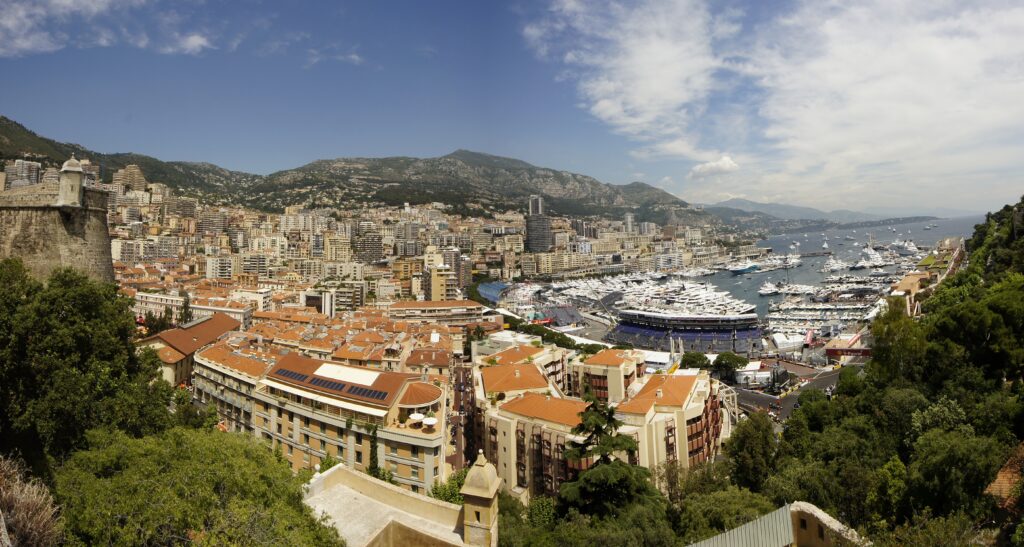
At Monaco, Formula 1 cannot escape the city. Buildings, barriers and the harbour press into the picture. A car that belongs to an extraordinarily sophisticated racing operation must negotiate a place that visibly has another life when the competition leaves.
That friction is the Grand Prix’s defining quality. The scenery supplies glamour, but the sporting story comes from constraint: how much speed, precision and ambition can be fitted into these streets?
A city race before the world championship
The Automobile Club de Monaco’s history dates the first Monaco Grand Prix to 14 April 1929. It records a 16-car starting field and victory for the driver known as Williams in a green Bugatti 35B.
Those details place the race well before the Formula 1 World Championship began in 1950. Monaco’s identity was already being formed around the unusual proposition of turning a town’s circulation routes into a sporting stage.
A purpose-built arena announces its function. A street circuit asks the viewer to hold two uses of a place in mind at once. That double image is part of the fascination: ordinary urban scale meets machinery designed for an exceptional task.
The glamour contains a difficulty
Formula 1’s circuit guide describes Monaco’s narrow, twisting roads and the challenge of their changing camber. Its identity is inseparable from the limited room available to the drivers.
This helps explain an apparent contradiction. The setting can look expansive in a panoramic harbour shot and intensely confined from an onboard camera. Both views are Monaco. The tension between them is more revealing than a simple division between sporting action and luxury spectacle.
The circuit also resists an easy equation between passing and drama. F1’s archive of Monaco overtakes treats successful moves as exceptional acts. Scarcity changes the meaning of an opening when one finally appears.
Senna gave the streets a human signature
F1’s historical account records Ayrton Senna’s six Monaco victories, the last in 1993. The association between driver and circuit is one reason a place can feel inhabited by sporting memory long after a particular race has ended.
A corner is still a physical turn, but it also becomes a prompt. The familiar location allows performances from different years to be remembered against the same visual language.
For Leclerc, the backdrop was home
When Charles Leclerc won in 2024, the story acquired another dimension. In his post-race interview, he connected the victory to the race that had inspired his ambition to become an F1 driver.
For the audience, Monaco may be a destination or a televised spectacle. For a driver raised there, those same streets can hold a personal history. The city supplies all three meanings at once.
That is Monaco’s enduring advantage as a sporting story. The circuit is never only a circuit. The place keeps entering the race.