
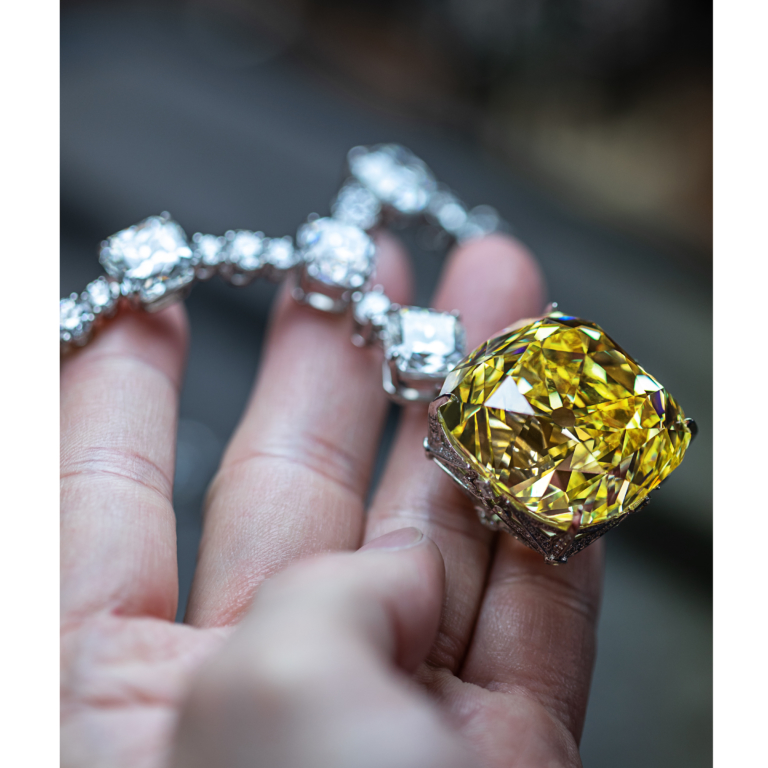
Audrey Hepburn wore the Tiffany Diamond for publicity photographs connected with Breakfast at Tiffany’s. Lady Gaga wore it to the Oscars decades later. The stone was the same; the images belonged to very different moments in popular culture.
That continuity is more interesting than attaching a speculative price to it. The diamond has a physical history, but it also has a second life made from photographs, settings and the people through whom audiences encounter it.
First, the stone
Tiffany’s account identifies the rough diamond as a 287.42-carat stone found in South Africa in 1877 and acquired by Charles Lewis Tiffany the following year. It was cut into a cushion-shaped brilliant weighing 128.54 carats.
The reduction is worth pausing over. The finished object was the result of decisions about form, not simply the preservation of the largest possible lump of material. Tiffany presents that transformation as a choice of beauty over size. Whatever language surrounds it, the numbers reveal how much material was removed to produce the jewel now recognised by its name.
Hepburn’s image, precisely
The house’s high-jewellery history places the stone in Jean Schlumberger’s Ribbon Rosette necklace for Hepburn’s promotion of the 1961 film. The distinction between publicity photography and a scene in the movie matters: the image can become so familiar that separate objects and moments blur together.
The necklace gave the diamond a setting in both senses. Metal and other stones held it physically; Hepburn and the film supplied a cultural frame. Jewellery was participating in the construction of an image, rather than merely completing an outfit.
A new stage with Lady Gaga
Tiffany’s own archive records the diamond being fitted for Lady Gaga for the 91st Academy Awards. That documented appearance supplies a fresh chapter without requiring a claim that the two women represented the same kind of stardom.
The attraction of the comparison lies in the difference. A historic object arrives with associations already attached, while its new wearer brings another public identity. Neither has to erase the other. The jewel can connect two images without making the later one a replica of the first.
Even a replica can carry the story
For Death on the Nile, costume designer Paco Delgado told British Vogue that Tiffany made replicas of the diamond for the film. That is another useful distinction: a recognisable jewel can become a cinematic character without the original stone being used on screen.
Its cultural identity has become portable. The colour, shape, name and history do enough work for an audience to follow the reference. Authenticity still matters, but the fictional appearance belongs to a different kind of storytelling.
The Tiffany Diamond’s lasting appeal is therefore not explained by carat weight alone. It is a rare object with a public biography. Each setting holds the stone; each appearance gives that biography another page.