
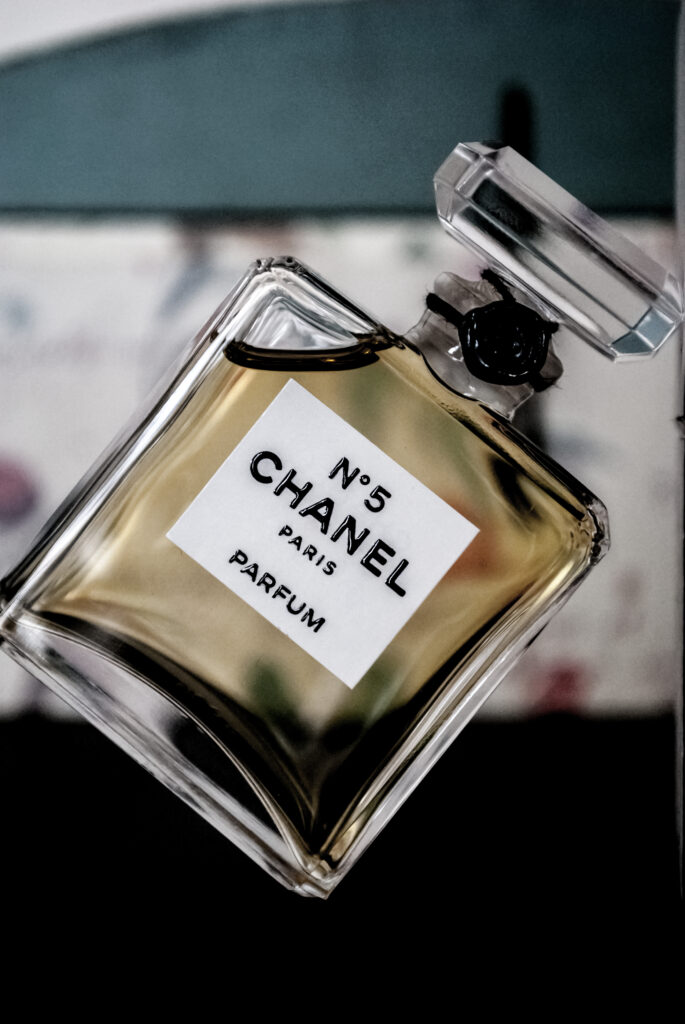
You can recognise Chanel N°5 without opening a bottle. The number, the rectangular outline, the spare label: the fragrance has a visual identity that reaches you before the scent does. It is an unusual achievement for an object whose central experience is invisible.
Its history sits at the intersection of several kinds of authorship. Gabrielle Chanel supplied a fashion identity, Ernest Beaux composed the perfume, and later images added associations that no list of fragrance notes could fully explain.
A number instead of a fantasy
In Chanel’s account of the creation, Gabrielle Chanel chose the fifth sample Beaux presented and kept the number as its name. The fragrance was introduced in 1921. The house connects that direct naming to a bottle distinguished by its white label and faceted stopper.
A number leaves an intriguing amount unsaid. It offers neither a location nor a ready-made romantic scene. The wearer has to supply some of the association. Set against the richness implied by perfume, the name has the crispness of an item in a series: exact, memorable and open to interpretation.
The smell was a composition, too
The Museum of Arts and Design’s Art of Scent education material describes Beaux combining floral materials with synthetic aldehydes. It treats N°5 as a work of olfactory art connected to Chanel’s persona and fashion enterprise.
That perspective is useful because the bottle can become so culturally loud that the composition recedes. N°5 is also the result of a perfumer arranging materials to create an effect. The image and the scent are related creative achievements, rather than one simply decorating the other.
Then Marilyn entered the picture
Chanel’s historical timeline documents Marilyn Monroe’s association with N°5 through her 1952 Life interview and Ed Feingersh’s 1955 photographs of her applying the fragrance. These are specific images and statements, not an invitation to invent details about her private life.
The connection changes the scale of the story. A small personal object becomes part of a public persona. Even someone who cannot identify its ingredients can understand the suggestion of glamour attached to a photograph. Perfume, which disappears into the air, gains a remarkably durable visual memory.
An icon can have more than one interpretation
N°5 has also been revisited from within the house. Chanel identifies Jacques Polge’s 1986 eau de parfum as a reinterpretation of the earlier composition. Continuity of name therefore does not require every version to be treated as an identical formula.
That is part of what makes the object interesting beyond nostalgia. A recognisable framework can hold creative variation, while the accumulated images remain available to a new audience.
N°5’s cultural power lies in that combination: a scent you must experience for yourself and a form you may feel you already know. Long before it touches the skin, the bottle has begun telling its story.