
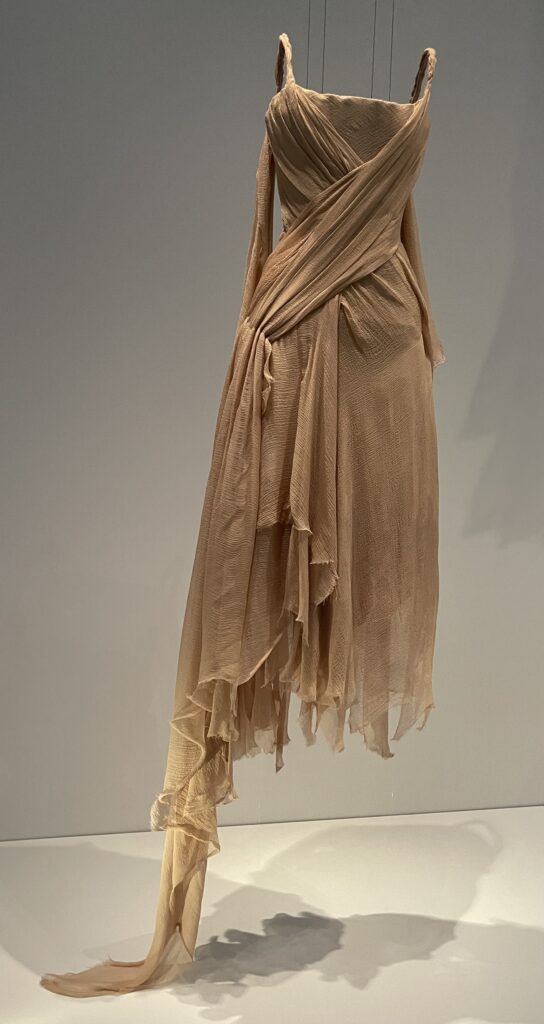
Alexander McQueen’s Oyster dress has the volume of a grand gown and the uneasy surface of something that has survived an ordeal. Pale silk gathers in ridges and loosened edges. The impression is lavish, but it resists the neatness usually expected of a luxury object.
That tension is the point. In the spring/summer 2003 collection Irere, beauty arrived with a story of shipwreck. The dress does not simply illustrate the sea. It lets the material appear to have a relationship with it.

A gown with a narrative already underway
The Metropolitan Museum of Art’s object record connects several Irere garments with a disaster at sea. Its account of the Oyster dress identifies the shell-like ridging of the organza and the waviness of the hem.
Those references create an image of transformation. A conventional evening gown might suggest preparation for an arrival. This one invites the thought of an aftermath. The cloth seems to carry an event rather than waiting for an occasion to give it meaning.
The reading is not dependent on assigning a literal identity to the wearer. It comes from the relationship between a refined garment and a surface that appears unsettled. The dress holds both impressions at once.
The layers are the plot
In the Met’s Savage Beauty exhibition material, curator Andrew Bolton discusses the many layers of silk organza and the collection’s shipwreck-and-landfall narrative. The exhibition entry also identifies georgette and chiffon among the materials.
Layering gives the gown its particular rhythm. The eye moves from edge to edge rather than gliding over one continuous expanse. Volume accumulates through repetition, while the irregular-looking surface prevents the result from becoming a simple geometric shape.
The shell reference is therefore more than a nickname. It offers a way of connecting structure and feeling: something protective yet fragile, built up in thin parts, with an outside that seems to record pressure and movement.
Control made the disorder possible
The Met’s introduction to Savage Beauty describes McQueen’s combination of tailoring and patternmaking with draping and dressmaking. It is valuable context for a design whose apparent disturbance could otherwise obscure its precision.
A convincing impression of disorder still has to work as a garment. Cloth must be placed, supported and related to a body. The emotional effect depends on decisions about shape and construction, even when those decisions are meant to feel instinctive or wild.
That is one of the pleasures of McQueen’s work: technical command does not always announce itself as smoothness. It can be used to make a garment look vulnerable.
Luxury with something unresolved
The Oyster dress offers a different kind of glamour from the immaculate surface. Its complexity allows delicacy and damage to occupy the same image. The viewer does not have to choose between admiring the workmanship and responding to the unease.
That is why the dress remains compelling as an object rather than merely as an item on a greatest-hits list. The story is embedded in how it is made. Take away the layers and disturbed edges, and the emotional proposition changes with them.
McQueen made the gown beautiful, then refused to let beauty be the end of the conversation.