
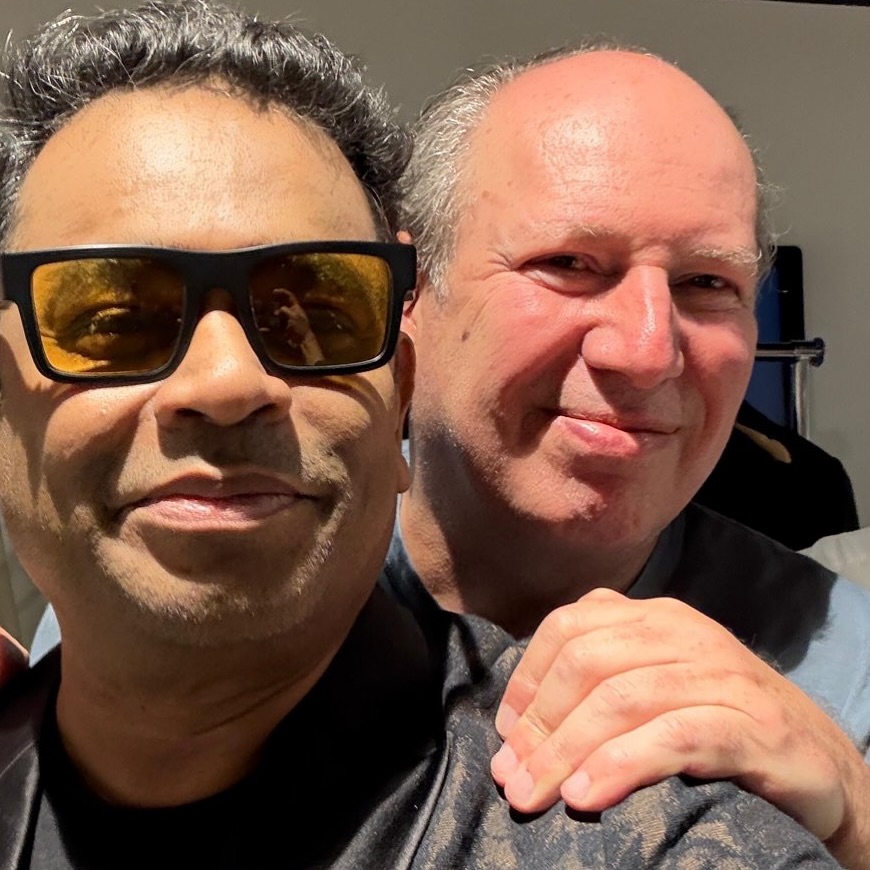
Two famous names on a soundtrack invite a simple question: which part belongs to whom? With Ramayana, A.R. Rahman has offered a more useful answer than guessing from a trailer. He and Hans Zimmer developed themes for the film; Rahman also took on its songs, working with lyricist Kumar Vishwas.
In an interview published by Indulge on 30 October, Rahman explained that both composers created themes that have a place in the film. He did not assign either musician a particular character or sequence. Instead, his account describes shared responsibility for the musical world, with a more distinct role for himself in the song-writing process.
The Songs Have Their Own Creative Partnership
Rahman singled out Vishwas’s command of language while discussing the songs. That detail matters: composing a tune and finding the words through which it tells a story are connected but different jobs. The collaboration is not simply two celebrated composers placing their signatures beside each other.
Nor does a shared music credit mean that every cue was written together. Rahman’s description allows for individual contributions within one film. Without a detailed track-by-track account, identifying a passage as entirely Zimmer’s or entirely Rahman’s would go beyond what he has explained.
A Score Built Through Revision
Speaking separately to The Hollywood Reporter India in an interview published on 27 October, Rahman described a project that had occupied him for roughly three and a half years. He recalled a friendly reunion in Zimmer’s studio and work together in London, Los Angeles and Abu Dhabi.
He also described the less glamorous part of the process: repeated revisions. Sometimes, he said, the team went through 13 iterations before returning to an earlier idea. The point was not endless change for its own sake: an early idea could prove the right one after several alternatives had been tested.
Multiple languages, versions of the film and evolving visual-effects work complicated the task. Rahman said the final three months involved scoring across Los Angeles, London, Budapest, Mumbai and Chennai. His account suggests a score shaped across recording locations as well as across musical approaches.
More Than a Two-Name Billing
Prime Focus Studios has presented the Rahman–Zimmer collaboration as part of its ambition to take Ramayana to international audiences. The interviews give that broad pitch a practical shape: separately developed themes, songs made with a lyricist, and a score revised around a large, multilingual production.
The film opens on 5 November. For audiences, the interesting question will be how these contributions work together when a song, a theme and a scene finally meet.