
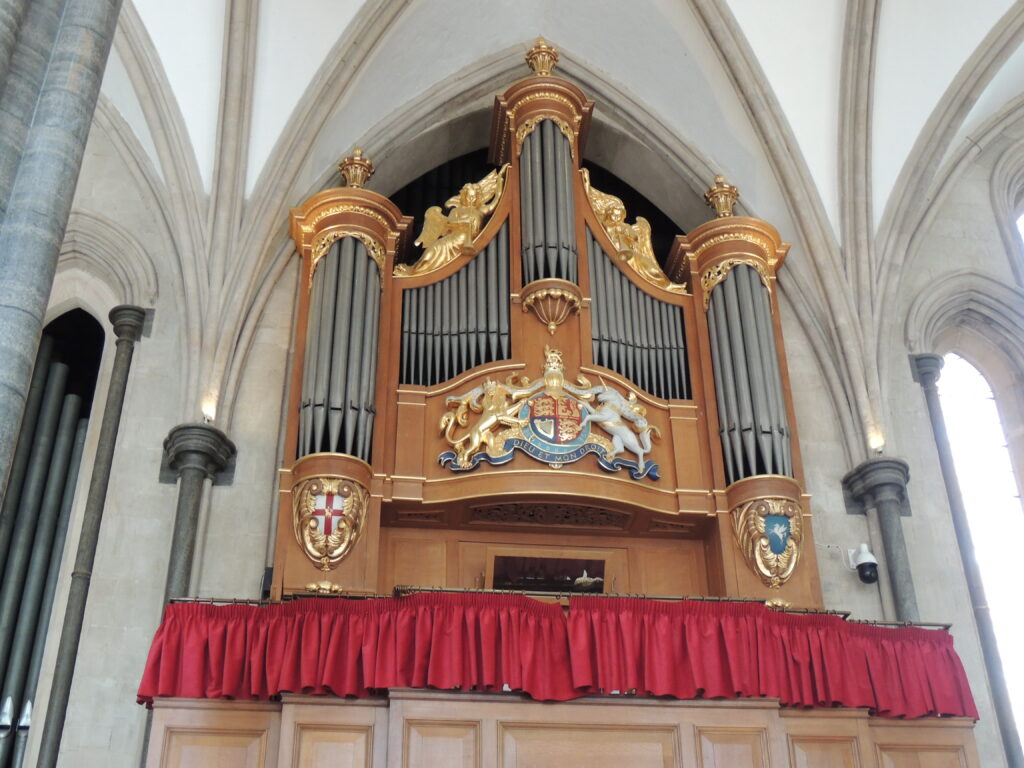
Hans Zimmer had a problem on the way to London. He had written organ music for Interstellar that he feared could not be played. In a recollection published on organist Roger Sayer’s website, Zimmer describes admitting this to Christopher Nolan during their flight. Then they met Sayer at Temple Church, and the supposedly impossible passages acquired a performer. Zimmer’s account credits Sayer’s precision and humanity.
It is a useful story to remember when the score starts to feel superhuman. Behind that enormous sound are fingers, feet, air-driven pipes and decisions made in a particular room. The music’s scale does not erase its physical origins. It makes them more arresting.
Nolan wanted the weight of history
The organ was absent from the first piece Zimmer sent Nolan. In a BAFTA conversation, the director explained that he proposed it because its scale and history felt right for the film. He wanted to move away from an immediately recognisable futuristic musical vocabulary. Nolan describes the choice in his BAFTA interview.
That decision gives Interstellar an unusual emotional register. A journey beyond familiar space is accompanied by an instrument associated with accumulated human time. The resulting tension can make the cosmos feel at once unreachable and strangely intimate. The instrument brings an older emotional vocabulary into the journey, giving its unfamiliar distances a connection to the world the characters have left behind.
A building becomes part of the instrument
Temple Church’s own history records that its present Harrison & Harrison organ was installed in 1954. Its case was modelled on drawings of the church’s seventeenth-century Father Smith organ. The instrument carries four manuals and three 32-foot stops. Those particulars belong to a real, long-used musical setting.
That setting matters to the story of the recording. In a first-person account for The Diapason, Sayer remembers microphones and cables filling the church, with even the organ’s blowers being recorded. The instrument was being explored as a source of sound in its own right, beyond the notes on the page. Sayer describes the sessions in detail.
Six parts, carefully assembled
Sayer recalls an intense six-day recording process. The music involved six separate organ parts, originally conceived for a sampled instrument, so some registration instructions needed adapting to Temple Church. He also had to play precisely to a click track to align with musicians recording elsewhere. The finished sweep depended on this exacting work.
Knowing that changes the pleasure of listening. The organ can seem like an unstoppable force, yet its presence was negotiated through collaboration: a composer’s ambition, a director’s ear, a performer’s knowledge of what this instrument could do. The recording contains both magnitude and minute adjustment.
The most memorable thing about the score may be that you can hear those qualities coexist. It reaches for distances the eye struggles to comprehend, while retaining the vulnerability of a performed phrase. At the centre of Interstellar’s vastness, somebody is still playing.