
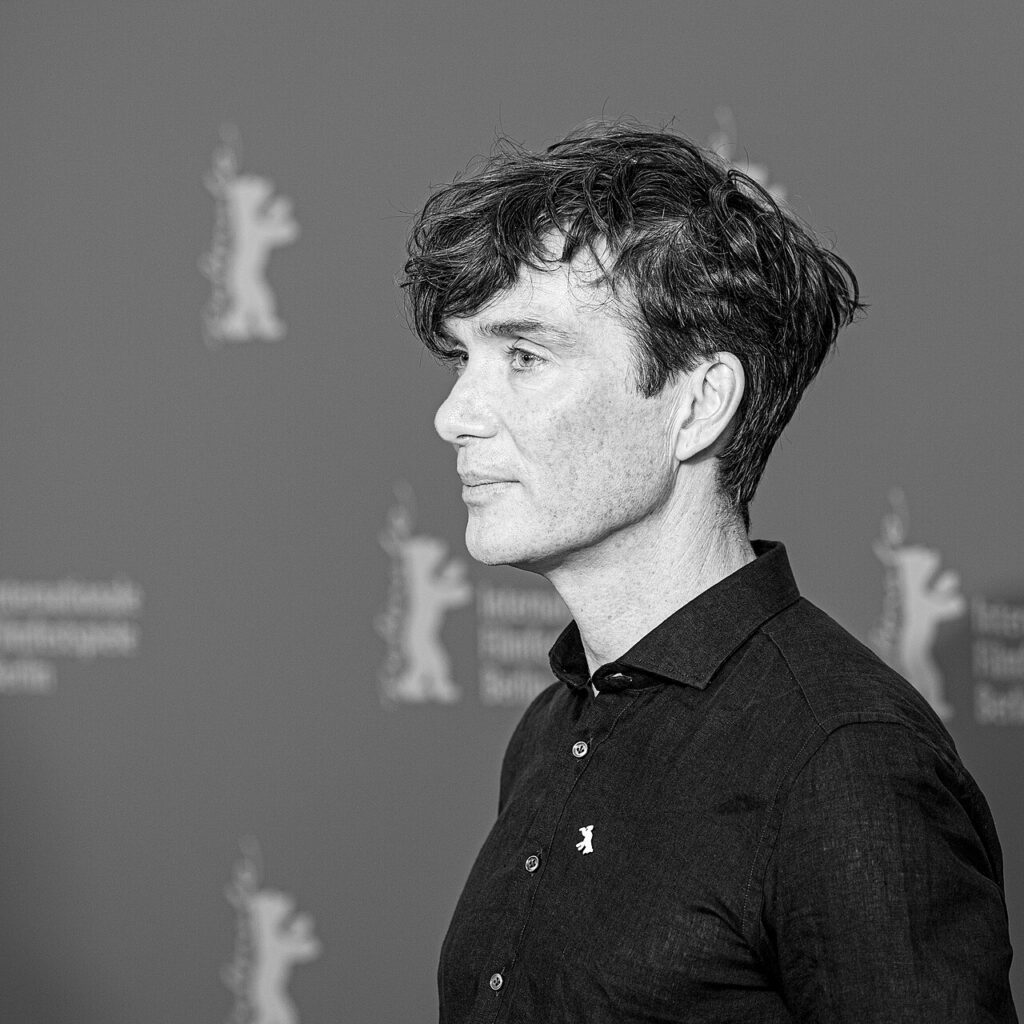
A film about the atomic bomb seems to offer an obvious argument for a giant screen. There is a desert, a detonation and a world-altering event. Yet one of Oppenheimer’s most interesting technical problems was much smaller: how close could a camera get to a face?
Christopher Nolan and cinematographer Hoyte van Hoytema were not only building towards an explosion. They were making a drama in which Cillian Murphy’s expressions had to carry thought, uncertainty and pressure at an enormous scale.
Turning the format inward
In an interview with The Credits, van Hoytema described the film as an inward turn for his collaboration with Nolan. He wanted large-format photography to bring viewers into the character’s experience, rather than leave them watching from a comfortable distance. His account puts intimacy at the centre of the technical choices.
That is a different ambition from simply making everything bigger. A distant landscape lets the eye roam. A close-up asks it to remain with a person. Enlarging that encounter can make the viewer feel less like a spectator surveying history and more like someone stuck in a difficult room with its consequences.
The distinction helps explain why the film’s format matters even when nobody is looking at the sky.
The equipment had to follow the idea
Van Hoytema needed lenses that could work closer to the actors. Panavision’s Dan Sasaki modified and engineered optics for the production; a separate watertight probe lens enabled unusual close views of small-scale material. These were solutions to particular images, not specifications chosen for a marketing badge. Kodak’s production interview details the collaboration.
The useful lesson is in the order of events. A desired emotional relationship between viewer and character came first. Engineering helped make that relationship possible. Technology becomes most interesting here when it answers an artistic demand that an ordinary setup cannot quite satisfy.
Black and white, made physical
The production also required Kodak to manufacture its Double-X black-and-white film in 65mm for the project. Making that stock work involved coordination with IMAX, Panavision and FotoKem, including changes to equipment and processing. The monochrome passages were captured on black-and-white film, rather than being only a colour image stripped of saturation afterwards.
Van Hoytema explained that the shift helped distinguish the storylines around Oppenheimer and Lewis Strauss. The visual change therefore performs narrative work as well as creating a striking surface. The cinematographer discusses that separation in the interview.
Scale is a question of attention
None of this requires a belief that one format makes every film superior. The more revealing point is that a filmmaker can use an expansive image to narrow our attention.
In Oppenheimer, the big-screen proposition includes the labour of reading another person: a hesitation, an unreadable look, a face that cannot explain itself quickly enough. The machinery is immense. The distance it wants to close is human.