
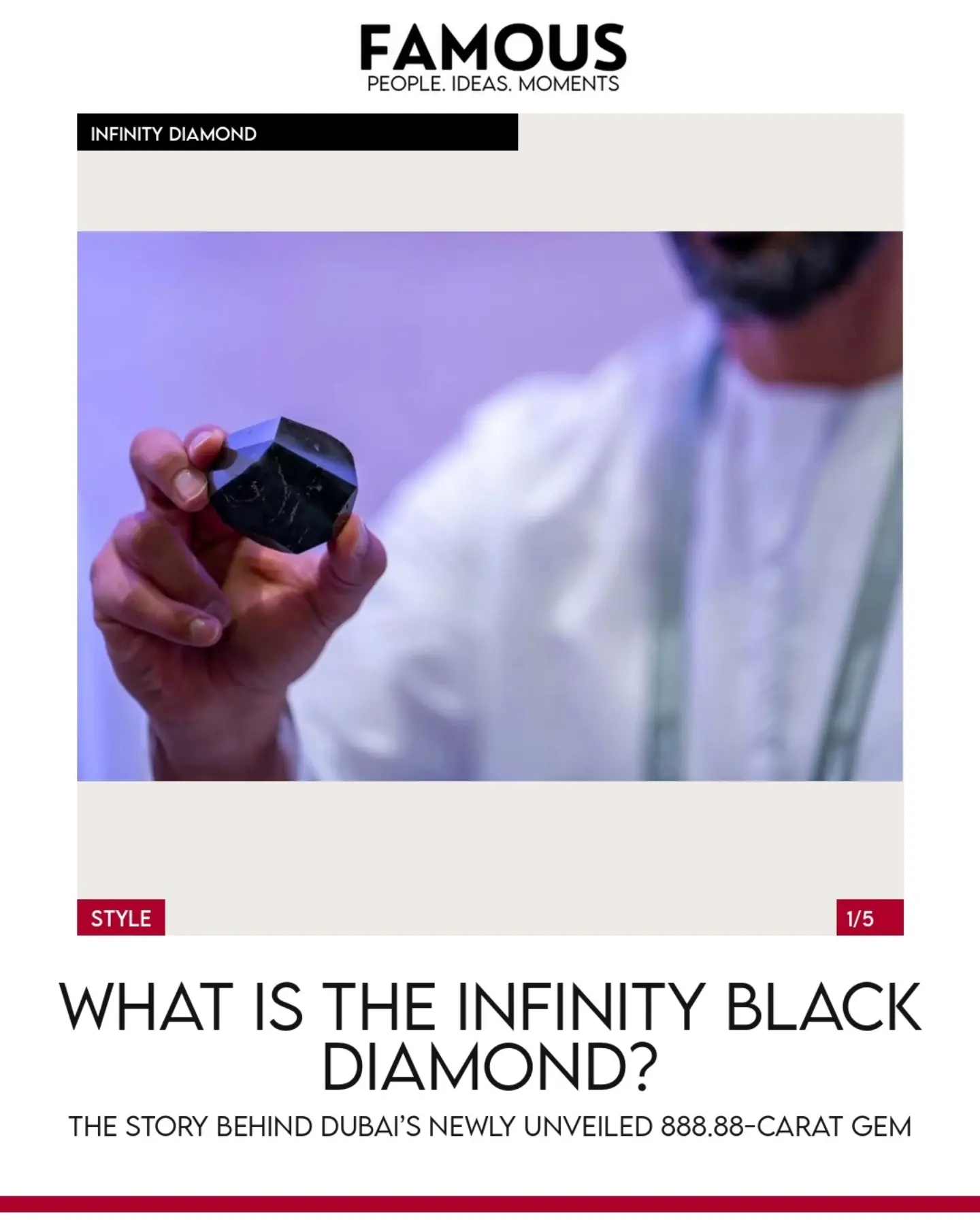
A black diamond weighing 888.88 carats made its public debut at the Dubai Diamond Conference on 26 October 2026. Named Infinity, the stone was presented by Diamond Trading NV, according to the event organiser, Dubai Multi Commodities Centre.
The number is remarkable, but it is only the beginning of the story. To understand an exceptional stone, the questions are also where it came from, what happened to it and which claims the available documentation actually supports.
From rough stone to finished object
DMCC describes Infinity as a fancy black natural diamond originating in the Democratic Republic of the Congo. Its account traces the finished stone to a 1,138-carat rough acquired in 1975 by Andrew Coxon on behalf of De Beers. Cutting took place between 2022 and 2024.
That timeline makes the unveiling different from a new discovery. The news is the presentation of the finished diamond, not a claim that the rough was recently found.
Be precise about the record
DMCC says GIA examined the rough in 2013 and described it as the largest single-crystal natural diamond it had examined and reported on at that time. That is a specific historical statement about an examination. It is not interchangeable with calling Infinity the world’s largest diamond today.
Famous has not independently inspected the stone or its laboratory report. The provenance above is attributed to the organiser, and no sale price or auction result is asserted here.
Why the craftsmanship matters
A finished jewel can make its earlier form difficult to imagine. The journey from rough to cut stone involves decisions about what to preserve and what to remove. Its final weight records one outcome of that process; it does not explain every judgement that produced the object.
That is a more rewarding way to approach a spectacular gem than treating size as a complete measure of significance. Provenance, appearance and workmanship are different questions, even when publicity gathers them into one dramatic reveal.
A reveal, not an investment recommendation
Infinity can be discussed as an extraordinary object without turning it into a promise of financial return. A conference presentation does not establish what a buyer would pay, whether a sale is planned or how any future transaction would unfold.
Would you look first at the diamond’s scale, its colour or the story of how it was cut?