
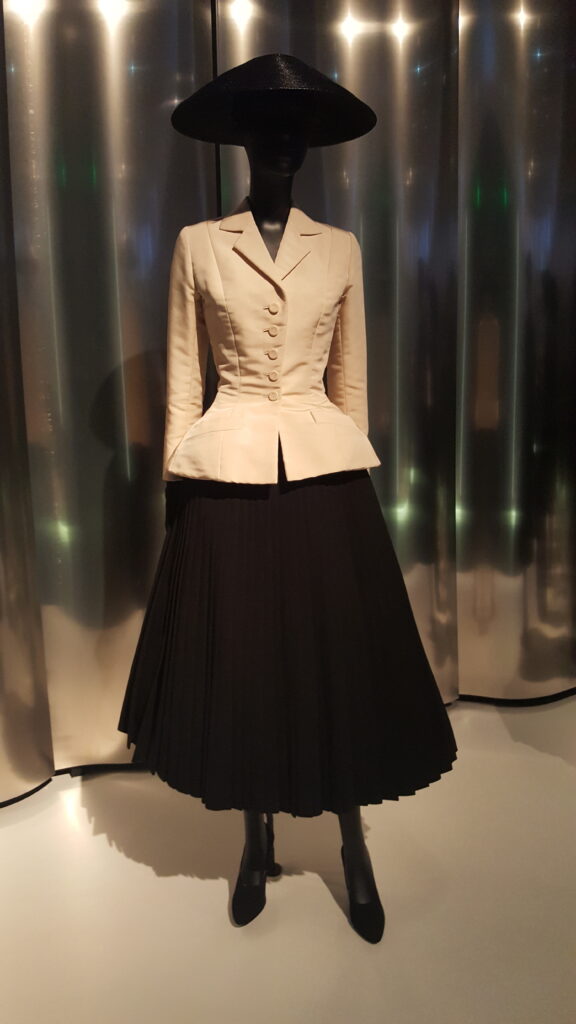
A narrow waist is only part of the story. On Christian Dior’s Bar jacket, the shape becomes meaningful because of the softly defined shoulders above it and the volume opening out below. The eye reads the whole arrangement, and a silhouette begins to act like a signature.
It is an unusually durable idea to have emerged from a first collection. Before decades of reinterpretation, the Bar belonged to one particular Paris presentation in February 1947.
The debut that acquired a name
Dior’s history dates the collection to 12 February 1947 at 30 Avenue Montaigne. The house identifies its lines as Corolle and En 8 and connects the expression New Look with the response of Harper’s Bazaar editor Carmel Snow.
The name helped turn a collection into a moment. Two words gave a set of clothes the force of a proposition: something in fashion had changed. The Bar ensemble supplied a shape through which that proposition could be remembered.
An argument made in proportions
The Metropolitan Museum of Art’s Bar record dates the ensemble to spring/summer 1947 and credits Christian Dior. Dior’s account of the jacket identifies the softly shaped shoulders, emphatic waist and flaring lower section among its defining features.
The effect depends on contrast within the garment. The waist appears more sharply defined because the silhouette has somewhere to expand. The lower volume gives the jacket a small architectural presence: it shapes the space around the body instead of merely tracing it.
That is also why reducing the design to a formula for flattering a figure misses its interest. The jacket is a constructed proposition about shape. Its importance does not depend on treating that proposition as an ideal every wearer ought to follow.
The statement had an inside
The Met’s Haute Couture catalogue draws attention to hand stitching inside the collar and to covered buttons stitched by hand. It places the New Look within the return of Parisian fashion authority after the Second World War.
The combination matters. A widely circulated image can stand for renewal, but the image still depends on specific workshop decisions. The famous outline is the public-facing result of work that is partly concealed when the garment is worn.
There is a useful tension here between the spectacular and the intimate. A collection can become a historical headline while its persuasive power also resides in the edge of a collar or the finish of a button.
Repetition without standing still
Dior describes successive creative directors returning to the Bar jacket. The enduring subject is therefore not a single garment preserved unchanged, but a set of relationships that can be recognised through new interpretations.
That is what gives a house signature its practical value. A designer can change material, context or styling while carrying forward an idea the audience understands. The history remains visible without requiring every new version to perform a costume drama.
The Bar jacket’s achievement is that its proportions can do this work before a label is read. Christian Dior gave his new house an outline, and later designers inherited something they could both recognise and reconsider.